
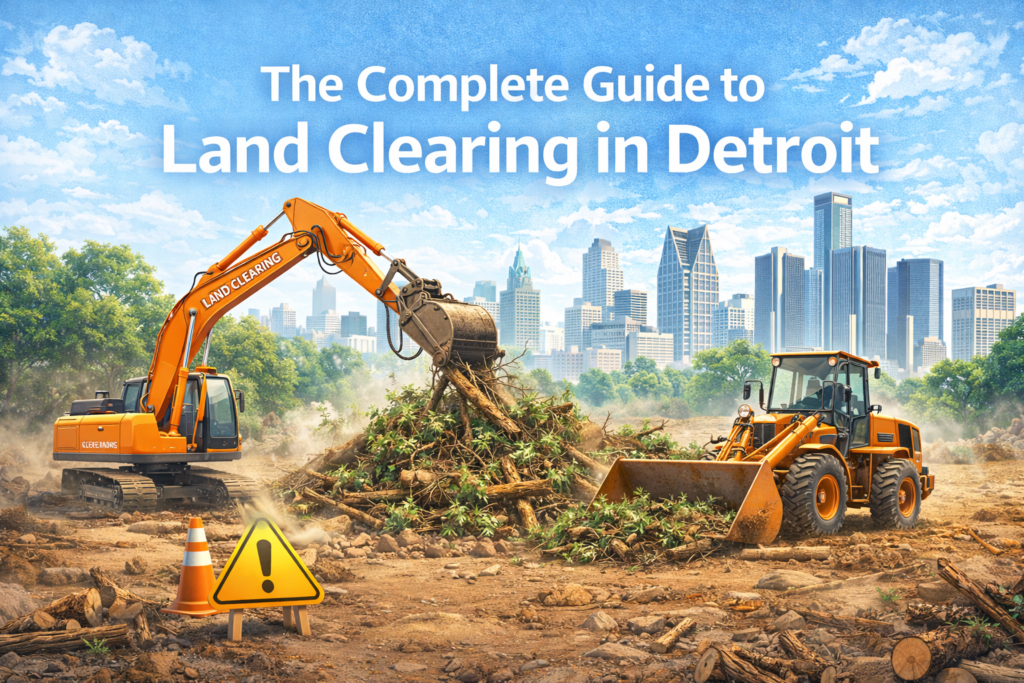
Detroit is a city full of land with potential. Vacant lots scattered across established neighborhoods. Overgrown parcels that haven’t seen a maintenance crew in a decade. Inherited properties where years of unchecked growth have turned usable ground into a tangled mess of brush, trees, stumps, and debris. Industrial sites waiting for redevelopment. Side lots that homeowners have been meaning to do something with for years.
If any of that sounds familiar, you’re not alone. Land clearing is one of the most common first steps for property owners and developers across the metro area — and it’s also one of the most misunderstood. A lot of people don’t know exactly what the process involves, how long it takes, what it costs, or what they should expect from a contractor when the work is done.
This guide answers all of that. By the end, you’ll know what land clearing actually means, which type of clearing your property needs, how to find a contractor who will do the work properly, and what Detroit-specific factors you need to account for before any equipment rolls onto your land.
What Is Land Clearing, Really?
At its most basic, land clearing means removing vegetation, debris, and obstacles from a piece of property to make it usable. But that broad definition covers a surprisingly wide range of work depending on the current state of the land and what you intend to do with it afterward.
A residential homeowner clearing a backyard that’s gotten overgrown with brush and small trees has a very different job ahead of them than a developer preparing a multi-acre commercial parcel for a new building. A property with shallow-rooted shrubs and vines needs different treatment than one covered in mature hardwood trees with deep root systems. Land that will be landscaped after clearing requires different preparation than land that will support a concrete foundation.
Understanding which type of clearing you need is the first step toward getting an accurate quote and ensuring the right work gets done.
The Main Types of Land Clearing Work
Basic brush and vegetation clearing is the entry-level version of the work. This involves removing overgrown weeds, vines, brambles, scrub brush, and small woody plants — the kind of growth that accumulates when a property sits untended for a season or two. It’s labor-intensive but mechanically straightforward, and it’s often handled with a combination of hand tools, brush cutters, and skid steers with brush-cutting attachments.
Lot clearing goes further. A full lot clear takes a property down to bare ground, removing all vegetation, surface debris, and obstacles above the soil line. This is what’s typically required when a property is being prepared for sale, new construction, or simply reclaimed for productive use after a long period of neglect. For Detroit’s many vacant and long-abandoned lots, this kind of clearing is often the starting point for any improvement.
Tree removal and clearing is a specialized component that involves felling trees, cutting them into manageable sections, and removing them from the property. Large trees require careful planning — they have to be dropped in a way that avoids damage to surrounding structures, neighboring properties, and underground utilities. Stump removal is typically a separate step, either through mechanical grinding or full extraction depending on what comes next for the site.
Clearing and grubbing is the most thorough form of land clearing and the one most often required before serious construction work begins. Grubbing involves removing not just what’s visible above the ground, but the root systems, stumps, and organic material buried beneath the surface. Roots left in the ground decompose over time, which causes soil to settle unevenly — a serious problem if you’re planning to build anything on top of it. Any project involving a foundation, paved surface, or engineered grade needs proper grubbing done first.
Forestry mulching is a method that uses a specialized attachment to grind trees, brush, and woody debris directly into mulch on site. Rather than hauling material away, the mulch is left on the property as a natural ground cover that suppresses weeds and controls erosion while it decomposes. It’s an efficient approach for large parcels where hauling debris is logistically complicated or costly.
Site preparation follows clearing and grubbing and shapes the cleared land for its next use. This includes rough grading to establish the proper elevation and slope, compacting disturbed soil so it can support loads, and setting up drainage patterns that direct water where it’s supposed to go. Site prep is the bridge between raw cleared land and a site that’s ready for construction.
Why Detroit Has a Particular Need for Land Clearing Services
Detroit’s history over the past several decades has left the city with an unusual amount of underutilized land. Decades of population loss, economic contraction, and property abandonment created a landscape dotted with vacant lots, overgrown parcels, and idle land in the middle of established neighborhoods. As the city rebuilds and investment returns, that land is increasingly being put back into productive use — and clearing is almost always the first step.
This pattern plays out across the metro area in different ways. In neighborhoods like Brightmoor, Bagley, and Warrendale, homeowners and community organizations have been acquiring adjacent lots for expanded yards, community gardens, and neighborhood greening projects. In Corktown, Eastern Market, and Midtown, developers have been assembling parcels for commercial and mixed-use projects that require full site clearing and preparation. Out along the major corridors and in older industrial zones, larger-scale land clearing supports redevelopment projects that are transforming the city’s edges.
Beyond the revitalization story, Detroit’s climate creates its own land clearing demands. Michigan winters are hard on neglected property. Ice, snow load, and freeze-thaw cycles accelerate the deterioration of old structures and underground infrastructure, and the cold winters followed by wet springs create ideal conditions for aggressive vegetation regrowth. A property that was cleared several years ago and then left untended can return to a tangled mess faster than most property owners expect.
Detroit-Specific Factors That Affect Land Clearing Work
Any contractor working on Detroit-area properties needs to account for factors that are specific to this market. These aren’t details you’ll encounter in a generic land clearing guide, but they matter enormously in practice.
Underground surprises are common. Detroit’s urban fabric has layers of history beneath it. Old foundations from demolished structures, abandoned utility lines, buried concrete, and debris from previous buildings can all be hiding under what looks like an ordinary overgrown lot. An experienced local crew knows to watch for these obstacles and has equipment and procedures for handling them when they appear.
Soil conditions vary by location. The Detroit metro sits on glacial till, and the specific mix of clay, sand, and organic material varies across the city. Clay-heavy soils in low-lying areas hold moisture and can become unstable when disturbed. Properties near the Detroit River or river tributaries often have saturated or soft soil conditions that affect how clearing and grubbing work is approached. Local knowledge about these conditions helps a clearing crew plan the job correctly from the start.
City permits and regulations apply. Clearing work in Detroit — particularly work involving tree removal or significant earthwork — may require permits from the city or county. Environmental regulations may also apply to properties near wetlands, floodplains, or other protected areas. A contractor who knows the local permitting landscape can navigate this efficiently; one who doesn’t can put your project at risk of stop-work orders and fines.
Invasive species are a widespread issue. Vacant Detroit lots are frequently overrun with invasive plants — Tree of Heaven (Ailanthus altissima) is particularly aggressive in urban environments, sprouting readily in disturbed soil and growing fast enough to cause structural damage to old foundations and pavement. Clearing invasive species isn’t just about aesthetics; it’s about preventing the same problem from coming right back after the clearing crew leaves.
How to Choose a Land Clearing Contractor in Detroit
The range of contractors offering land clearing services in the Detroit area runs from large civil earthwork firms handling commercial projects down to individuals with a pickup truck and a chainsaw. Finding the right fit for your project means asking the right questions and knowing what the answers should look like.
Confirm they have the right equipment for your job. Different clearing jobs require different machines. Brush and light vegetation can often be handled with skid steers and brush cutters. Large trees require equipment with the reach and power to fell and process them safely. Grubbing operations need excavators with the attachment and capability to extract root systems. A contractor who shows up with the wrong machine for your site is going to have trouble — and you’ll be the one absorbing the schedule delays.
Ask about debris disposal. Where does everything go after it’s cleared? Legitimate contractors have established relationships with disposal facilities or processes for chipping, mulching, or recycling cleared material. Anyone who proposes burning debris on an urban lot should be a red flag, both because of fire risk and because open burning is tightly regulated within city limits.
Get clarity on what “cleared” means. When the job is done, what will the property actually look like? Will stumps be removed or ground down? Will roots be grubbed out? Will the surface be rough-graded? Will all debris be hauled off the property? These details should be spelled out in your contract before work begins, not discussed after the crew has left and you’re looking at a half-finished site.
Look for evidence of local work. A contractor who has actually cleared lots and prepared sites in Detroit neighborhoods will be able to point to specific projects, reference past clients in the area, and speak knowledgeably about local conditions. Generic claims of experience mean less than specific examples of work done in similar environments.
Verify licensing and insurance. Land clearing involves heavy equipment, falling trees, and significant ground disturbance — all of which create real liability exposure. Any contractor working on your property should carry current general liability insurance and workers’ compensation coverage. Confirm this in writing before the first machine arrives on site.
What to Expect During the Land Clearing Process
For most residential and small commercial projects, the clearing process follows a predictable sequence. The contractor assesses the site, identifies any hazards or underground concerns, and develops a plan for how the clearing will be sequenced. Larger trees are typically addressed first, followed by brush and vegetation clearing, and then grubbing if root removal is required. Debris is chipped, mulched, or loaded for hauling throughout the process rather than piled up and addressed at the end.
Once the surface is cleared, the site may be rough-graded to remove obvious high and low spots. If site preparation for construction is the end goal, a more formal grading plan may follow, potentially along with soil compaction testing and drainage system installation.
Timeline varies with the size and complexity of the project. A standard residential lot in reasonable condition might be fully cleared in a single day. A large overgrown parcel with mature trees and significant grubbing requirements could take several days or longer. Weather is also a factor — wet conditions can make grubbing and grading difficult or impossible without causing more soil disturbance than intended.
The Right Time to Clear Is Before Problems Get Worse
One thing that’s true of nearly every overgrown or neglected Detroit property: the longer you wait, the harder and more expensive the clearing job becomes. Invasive trees grow fast. Root systems spread. Debris accumulates. Structures deteriorate further. What might be a straightforward one-day clearing job today can become a significantly more complex project a year or two from now.
If you’re ready to stop looking at that overgrown lot and start doing something with it, the time to move is now. Getting a proper Land Clearing Detroit crew on site early in your planning process means you’ll have accurate information about site conditions, a realistic timeline for getting the land ready, and the peace of mind that comes from working with people who know this city and know how to prepare its land for what comes next.
Final Thoughts
Land clearing is where Detroit’s revitalization starts — at ground level, before any construction, any landscaping, or any productive use of property can begin. Whether you’re a homeowner reclaiming a neglected lot, an investor preparing land for development, or a contractor assembling a site for a larger project, the quality of your clearing work sets the tone for everything that follows.
Take the time to understand what your specific property needs, find a contractor with proven local experience, and make sure the scope of work is clear and committed to in writing before the first machine rolls on site. Do those things and you’re set up for a clearing project that actually delivers what you need: clean, stable, properly prepared ground ready for whatever comes next.
Detroit has too much potential sitting in neglected parcels to leave them overgrown any longer. Get them cleared and get them working.